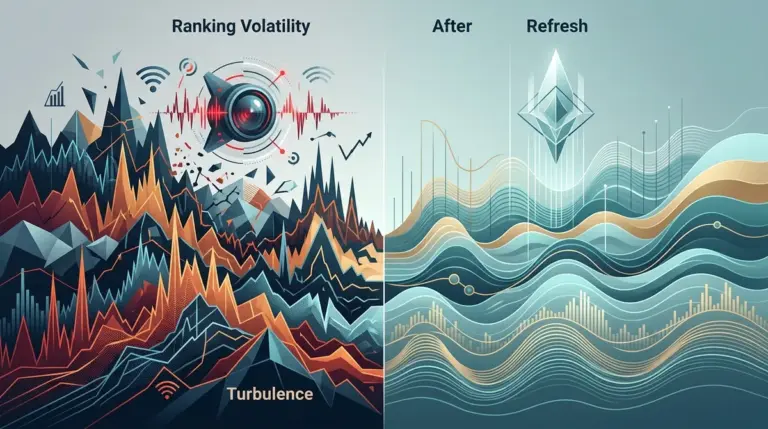
When a landing page oscillates between position four and position fourteen over a seventy-two-hour period, most SEOs mistake it for a temporary algorithm glitch. It is rarely a glitch. Repeated ranking swings—often called the "yo-yo effect"—are high-fidelity signals that Google’s ranking engine is struggling to categorize your content or is actively testing its utility against real-time user behavior. This instability suggests your page is sitting on a relevance threshold: it is "good enough" to appear on page one, but "weak enough" to be displaced by any minor shift in search intent or competitor freshness.
The Intent Mismatch Signal
The most common driver of extreme volatility is an unresolved conflict between the page’s content and the searcher's intent. If a keyword has "fractured intent"—where some users want to buy and others want to learn—Google will rotate different types of pages into the top spots to measure engagement. If your page is a long-form guide but the SERP is shifting toward transactional product grids, you will see your page dropped to the bottom of the first page or the top of the second as Google prioritizes the "buying" intent. When the algorithm re-tests the "learning" intent, your page pops back up.
Diagnosis: Examine the SERP during a peak and a trough. If the top five results change from "How-to" articles to "Best [Product]" lists while your page drops, you are fighting an intent shift. You cannot fix this with backlinks; you must adjust the content structure to serve both intents or pivot to the dominant one.
Algorithmic Testing and User Signals
Google uses "interleaving" and other live testing mechanisms to see how users react to a result they haven't seen in the top three before. If your page suddenly jumps five spots, Google is measuring your Click-Through Rate (CTR) and, more importantly, your "short click" vs. "long click" ratio. If users click your result but immediately bounce back to the SERP to click a competitor, your rankings will plummet in the next refresh. This cycle repeats until the algorithm gathers enough data to permanently demote or promote the page.
Warning: Avoid making major on-page changes during a high-volatility window. Rapidly changing title tags or meta descriptions while Google is in a "testing phase" can reset the data collection process, extending the period of instability and potentially landing the page in a lower baseline position.
Technical Instability and Rendering Failures
Not all swings are caused by the algorithm's whims; some are triggered by the page's technical performance. If your server response time is inconsistent or if your page relies heavily on client-side JavaScript that occasionally fails to render, Googlebot may see different versions of the page during different crawls. A "partial render" can lead to the temporary loss of key semantic signals, causing the page to drop until the next successful full render.
- Cumulative Layout Shift (CLS): High volatility in visual stability can lead to poor user experience signals, triggering a ranking drop.
- Intermittent 5xx Errors: If your hosting environment throttles Googlebot during peak traffic, the resulting crawl errors will cause immediate, temporary de-indexing of specific elements.
- Mobile-First Inconsistency: If your desktop site is robust but your mobile version hides critical content, your rankings will swing as Google’s mobile-first indexer reconciles the two versions.
The Impact of Freshness and Competitive Density
In high-competition niches like SaaS or Fintech, ranking swings are often the result of "micro-updates" by competitors. When a competitor refreshes a 2,000-word guide with new statistics or a 2024 timestamp, Google may give them a "freshness boost." This pushes the existing hierarchy down. If multiple competitors are updating content on a rolling basis, your page will appear to swing wildly as it reacts to the shifting "freshness score" of the surrounding pages.
Link Profile Fragility
If a landing page relies on a small number of high-authority links, and those links are on pages that are themselves volatile, the "link juice" flowing to your page will fluctuate. Furthermore, if Google’s SpamBrain identifies a pattern of suspicious links, it may temporarily discount those links while it validates their source. This results in a sudden loss of "authority weight," causing the page to drop until the link value is either restored or permanently neutralized.
Identifying the "Baseline" vs. the "Peak"
To understand what a swing is telling you, you must identify your baseline. If your page spends 80% of its time at position 12 and 20% at position 4, your baseline is 12. The peaks are "tests." If you spend 80% of the time at position 4 and occasionally drop to 12, your baseline is 4, and the drops are likely due to technical issues or temporary competitor boosts. Analyzing the frequency and duration of these movements allows you to determine if you are defending a position or trying to break into one.
Stabilizing Your Rankings: A Remediation Workflow
To stop the yo-yo effect, you must remove the variables that cause Google to doubt your page's relevance. Start by hardening your technical infrastructure. Ensure that your Time to First Byte (TTFB) is consistent and that all critical content is delivered in the initial HTML payload rather than through deferred JavaScript. This ensures that every time Googlebot visits, it sees the exact same "relevance signals."
Next, address the content depth. If your page is swinging, it likely lacks "coverage gaps" that your competitors are filling. Use a natural language processing (NLP) analysis to identify entities and topics that are present in the top three results but missing from your page. By increasing the "information density" of the page, you provide more "hooks" for the algorithm to latch onto, making it harder for a competitor to displace you on the basis of content quality alone.
Finally, look at your internal linking structure. A page that is only supported by a few external links is vulnerable. By routing internal "equity" from your highest-authority, most stable pages to the volatile landing page, you create a "moat" of internal relevance that can buffer against external volatility and algorithm updates.
Frequently Asked Questions
Is SERP volatility always a sign of a penalty?
No. Volatility is rarely a penalty. It is usually a sign of "relevance testing" or "intent mismatch." A penalty typically results in a sharp, permanent drop across all keywords, whereas volatility is characterized by rapid, temporary fluctuations.
How long should I wait before reacting to a ranking swing?
Wait at least 7 to 10 days. Google often runs short-term tests that revert automatically. Reacting too quickly—by changing URLs or rewriting headers—can cause more harm than good by interrupting the algorithm's data collection phase.
Can high bounce rates cause ranking swings?
Directly, no; Google has stated they don't use Analytics data for ranking. However, "pogo-sticking" (returning to the SERP immediately) is a signal they monitor. If your page has a high pogo-sticking rate, Google will likely rotate your page out of the top spots to see if another result satisfies the user better. If your page has a high pogo-sticking rate, Google will likely rotate your page out of the top spots to see if another result satisfies the user better, making diagnosing page-level ranking volatility a key SEO task.
Do Core Web Vitals impact ranking stability?
Yes. While they are a minor ranking factor, they are a major stability factor. Pages with poor vitals are more likely to be displaced during "quality updates" because Google prioritizes the user experience of the top-tier results.