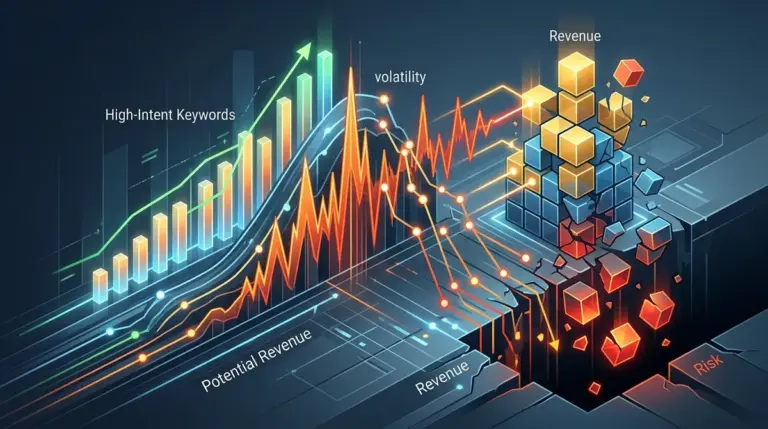
Keyword position volatility is the delta between a stable ranking and the erratic movement of a URL within search engine results pages (SERPs). For SEO professionals, volatility is not merely a metric of change; it is a diagnostic signal that indicates algorithmic testing, intent shifts, or technical instability. High volatility often precedes a core update, but it can also signal that a specific keyword niche is undergoing a re-evaluation of content relevance. Understanding whether a rank drop is a site-specific failure or a market-wide tremor is the difference between a strategic pivot and a panicked, unnecessary site overhaul.
Quantifying the Delta: What Volatility Signals Really Mean
Volatility is measured by the frequency and magnitude of ranking changes across a specific set of keywords over a defined period. When we talk about "sensing" the SERP, we are looking for noise that deviates from the baseline. Standard daily flux—where a keyword moves from position 3 to 4—is expected. Significant volatility involves double-digit jumps, the sudden disappearance of URLs from the top 100, or the rapid cycling of different pages from the same domain for a single query.
Best for: Identifying early-stage algorithmic shifts before they are officially confirmed by search engines.
High volatility scores across an entire industry suggest that Google is re-weighting specific ranking factors, such as E-E-A-T signals or backlink quality. Conversely, if volatility is localized to your domain while your competitors remain stable, the issue is likely internal—ranging from crawl errors to content decay or "cannibalization," where multiple pages compete for the same intent, causing the algorithm to cycle through them indecisively.
Distinguishing Between Market-Wide Flux and Site-Specific Decay
To act effectively, you must categorize the movement. Market-wide flux affects all players in a vertical. If every major publisher in the "fintech" space sees a 15% drop in visibility simultaneously, the volatility is systemic. Site-specific decay, however, is a localized loss of "trust" or relevance. This often manifests as a slow bleed in rankings or a sudden "cliff" drop while the rest of the SERP remains buoyant.
The Role of Query Deserved Freshness (QDF)
Some volatility is intentional and baked into the search intent. For news-heavy or trending topics, Google employs QDF. This mechanism prioritizes newer content, causing older, more authoritative pieces to drop temporarily until the "news cycle" for that query stabilizes. Sensing this type of volatility prevents SEOs from over-optimizing evergreen content that is simply being temporarily displaced by the temporal nature of the query.
Intent Shifts and SERP Feature Intrusion
Volatility isn't always about blue links moving up or down. Often, the "position" of a keyword changes because Google has inserted a massive "People Also Ask" block, a Video Carousel, or an AI-generated overview. These features push organic results below the fold. In these instances, your "position 1" might still be position 1, but your click-through rate (CTR) will plummet. This is "feature-driven volatility," where the layout of the SERP itself is the unstable element.
Warning: Never implement site-wide technical changes during a period of high global SERP volatility. Data gathered during an algorithmic update is "dirty" data. Wait for the volatility score to return to a baseline before diagnosing site-specific issues, or you risk fixing problems that don't exist.
A Diagnostic Framework for Sudden Rank Displacement
When the sensor indicates high turbulence, follow this tiered diagnostic approach to determine your level of exposure:
- Check the Scope: Is the movement limited to a single page, a subfolder (e.g., /blog/), or the entire root domain? Subfolder-level volatility often points to content quality issues, while root-domain drops suggest technical or authority-based penalties.
- Analyze the "Winners": Look at the pages that replaced you. If they all share a specific format (e.g., long-form guides replaced by short-form product pages), the volatility was caused by an intent shift.
- Verify Indexation Integrity: Use search console data to ensure the volatility isn't caused by a "noindex" tag or a robots.txt block that was accidentally deployed.
- Monitor SERP Feature Changes: Determine if a new featured snippet or local pack has been introduced, effectively demoting all organic results.
Executing a Volatility Mitigation Strategy
Stabilizing your SERP footprint requires a move away from "keyword chasing" and toward "intent dominance." If a keyword is highly volatile, it usually means the search engine is not yet confident in what the user actually wants. To mitigate this, ensure your content covers the primary, secondary, and tertiary intents associated with the query.
Technical stability is the second pillar of mitigation. Ensure that your Core Web Vitals are within the green threshold and that your internal linking structure provides a clear hierarchy. Algorithms often use these technical signals as "tie-breakers" during periods of high volatility. When the SERP is in flux, the most technically sound and "clear" result is often the one that regains its position first once the dust settles.
Finally, monitor the "recovery curve." After a period of high volatility, rankings rarely return to their exact previous state. There is a new baseline. Your goal is to identify this new baseline within 14 days of the initial spike and adjust your performance benchmarks accordingly. If you remain 20% below your previous average after the volatility subsides, a content refresh or a strategic backlink campaign is required to reclaim lost ground.
Frequently Asked Questions
What is a "normal" level of keyword volatility?
A normal level of flux involves 1-3 position shifts for keywords on the first page. Anything exceeding a 5-position shift for multiple high-volume keywords within a 24-hour period is considered high volatility and requires investigation.
Does high volatility always mean a Google update is happening?
Not necessarily. While high volatility is a hallmark of core updates, it can also be caused by a "refresh" of a specific industry's index, a change in how Google interprets a specific set of SERP features, or a major competitor launching a massive amount of new content.
How long should I wait before reacting to a rank drop?
Standard practice is to wait 7 to 10 days. Search results often "rubber-band"—dropping significantly during an update and then snapping back to their original position once the data centers have fully synced the new rankings.
Can volatility be positive for a website?
Yes. Volatility is simply movement. For sites with high-quality content that has been undervalued, a period of high SERP volatility is often the mechanism by which they leapfrog established, but stagnant, competitors.